
SVID:202609150002Pending assignmentSummary
The SigenCloud platform provides a function that allows administrators to send emails as Sigenergy. During testing it was found that the endpoint lacks authorization checks, making it possible to send emails with a normal installer account as well.
An attacker can abuse this to carry out phishing campaigns — emails are delivered from the official address notice@sigenergy.cloud, making them appear authentic to recipients.
Handling Timeline
Vulnerability reported
The missing authorization issue was reported to the Sigenergy Security Incident Response Team by Humza Ahmad (DIVD team volunteer).
Vulnerability details received
Full technical details, including the affected endpoint and reproduction steps, were received and triaged.
Fix deployed
Authorization checks were enforced on the email-send functionality, restricting it to authorized administrators.
Fix verified
The remediation was verified — installer accounts can no longer send emails as Sigenergy.
Affected Products / Components
| Component | Endpoint / URL | Environment |
|---|---|---|
| Email-send functionality | https://web-eu.sigencloud.com/power/email-send | Production (EU) |
notice@sigenergy.cloud
Vulnerability Description
The email-send functionality is intended for administrators to send messages to users as Sigenergy. The endpoint does not verify that the caller holds an administrative role; a normal installer account can invoke it and send arbitrary emails that appear to originate from Sigenergy.
Because the emails are sent from the official notice@sigenergy.cloud address, recipients are likely to trust the content, which makes the flaw well-suited to phishing campaigns.
Root Cause
- Missing function-level authorization. The endpoint does not enforce that the caller has an administrative role (Broken Function Level Authorization / BFLA).
- Insufficient role separation. A low-privilege installer account can invoke an administrator-only capability.
CVSS v4.0 Scoring
The report assigns a CVSS v4.0 Base Score of 6.9 (High).
| Metric | Value | Meaning |
|---|---|---|
| Attack Vector (AV) | Network | Exploitable over the internet. |
| Attack Complexity (AC) | Low | The endpoint is directly callable. |
| Attack Requirements (AT) | None | No special preconditions. |
| Privileges Required (PR) | Low | A single installer account. |
| User Interaction (UI) | None | No victim interaction required to send. |
| Vulnerable System Integrity (VI) | Low | Unauthorized sending of official emails. |
| Subsequent System Confidentiality (SC) | Low | Phishing targets may disclose information. |
| Subsequent System Integrity (SI) | Low | Recipients may act on forged official emails. |
Evidence Screenshot
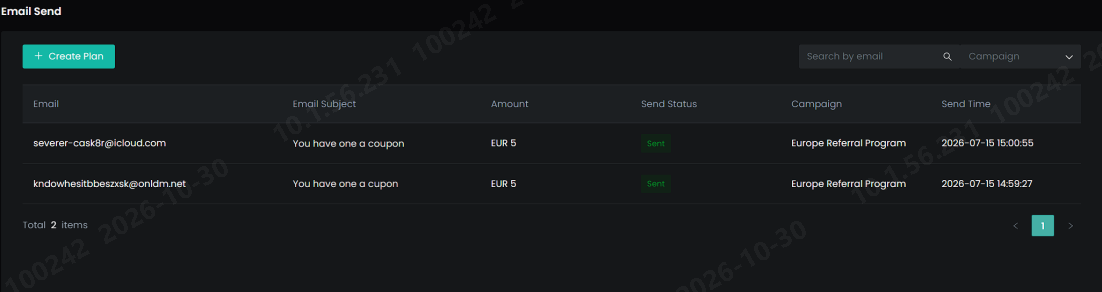
The screenshot below (from the security report) shows the Email Send functionality page:
Impact
A successful attack lets an attacker send emails that appear to come from Sigenergy's official address:
- Phishing campaigns — forged emails from
notice@sigenergy.cloudcan trick users into disclosing credentials or other sensitive information. - Brand and trust damage — official communications can be spoofed at scale.
Remediation & Recommendations
- Enforce proper authentication and authorization checks on all API endpoints, especially administrator-only functions.
- Restrict the email-send capability to explicitly authorized administrator roles.
- Audit other privileged functions for missing function-level authorization.
Additional hardening (recommended)
- Add rate limiting and approval workflows for bulk email sending.
- Log all outbound email sends for auditing and anomaly detection.
- Implement email authentication (SPF / DKIM / DMARC) to help recipients verify legitimate messages.
References
- Affected endpoint:
https://web-eu.sigencloud.com/power/email-send - Weakness:
CWE-862(Missing Authorization) - OWASP API Security Top 10 2023 —
API5:2023(Broken Function Level Authorization)